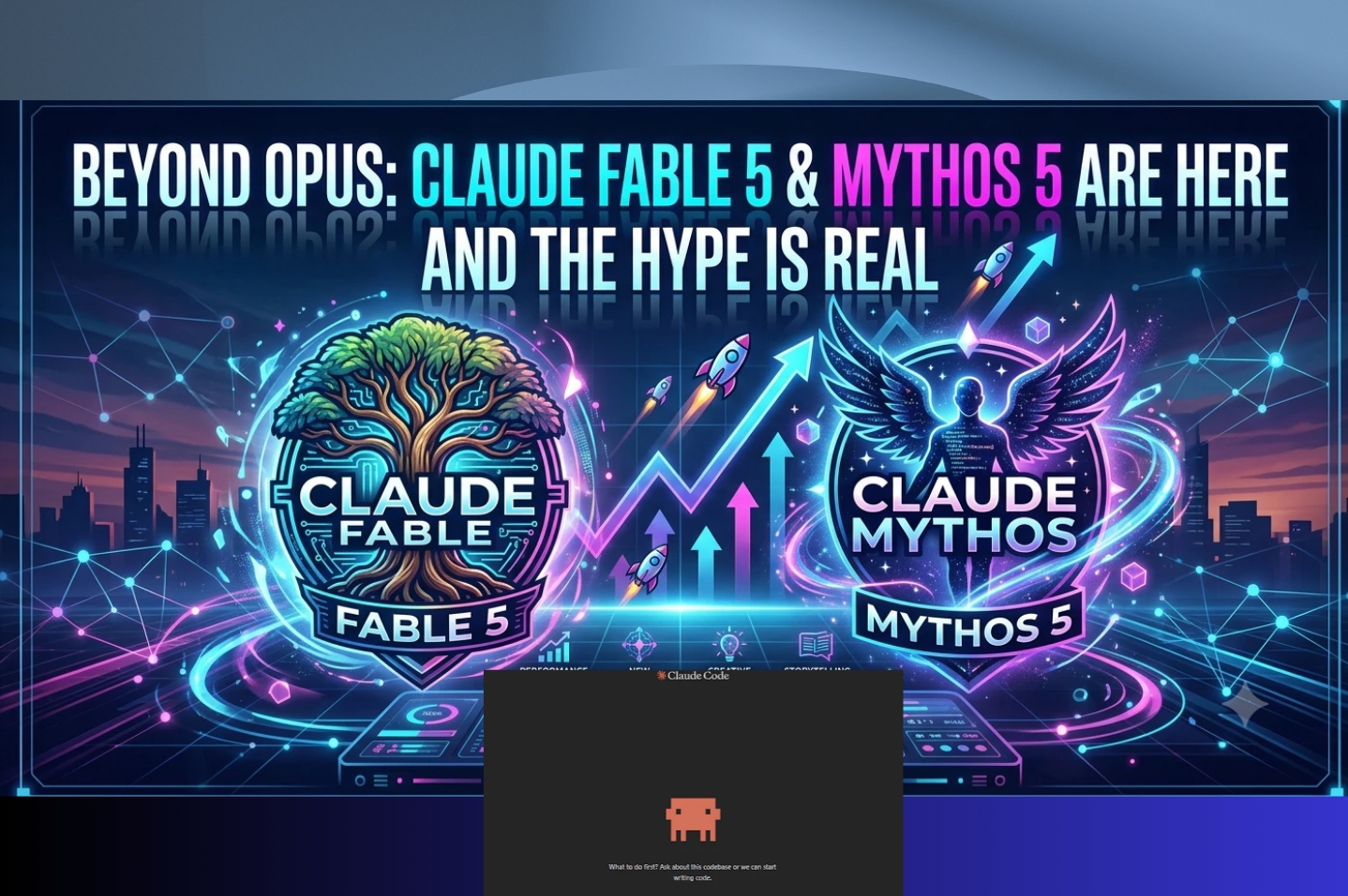
Beyond Opus: Claude Fable 5 & Mythos 5 Are Here – and the Hype Is Real
If you’ve been following AI news this week, you’ve probably seen the buzzwords “Mythos-class” and “Fable 5” flying around. Let’s cut through the noise: this launch is not vaporware. On June 11, 2026, Anthropic officially released Claude Fable 5 and Claude Mythos 5 — two names for the same, state-of-the-art model that resets the bar for what a publicly available AI can do.
Here’s what you need to know about the model that’s already topping independent leaderboards and making “Opus-class” look like last year’s news.
Same Brain, Two Names
First, a crucial clarification: Fable 5 and Mythos 5 are identical in capability. Anthropic uses two different aliases for branding and access tiers, but under the hood it’s the exact same model. Think of it as one intelligence, two doors.
What really matters is where that intelligence lands. Anthropic is calling this a “Mythos-class” model — a tier that sits above Opus, making it the most capable model the company has ever shipped to the general public.
Benchmarks That Actually Mean Something
The performance figures aren’t internal cherry-picking. Independent evaluators like Artificial Analysis, Hebbia, and the SWE-Bench team have put Fable 5 through its paces, and the results are exceptional:
- AA-Omniscience Index: #1 overall. This benchmark balances factual recall against hallucination, and Fable 5 comes out on top.
- Artificial Analysis Intelligence Index: Leads Claude Opus 4.8 by 4–9 points — a significant jump at this level of capability.
- SWE-Bench Pro (real-world software engineering): 80.3%. That’s ~11 percentage points above Opus 4.8, and a staggering 20+ points ahead of GPT-5.5.
These aren’t abstract language puzzles. SWE-Bench Pro tests the model on genuine codebase issues — the kind of work that gets you promoted, not just likes on Twitter.
Where Fable 5 / Mythos 5 Excels
The leap isn’t just about benchmark scores. Early testers and partner organizations are seeing transformative gains in several high-value domains:
- Agentic coding: Runs long-horizon software tasks, autonomously debugs complex multi-file codebases, and navigates terminal environments with ease. On Terminal-Bench Hard, it’s the new king.
- Knowledge work: Legal document synthesis, deep financial analysis, and long-form research are where the model’s improved reasoning and recall shine.
- Cybersecurity: In controlled red-teaming exercises, the model uncovered thousands of zero-day vulnerabilities — a double-edged capability that underscores both its power and the need for responsible deployment.
- Spatial reasoning: Finally, a model that can reliably interpret engineering diagrams, floor plans, and technical drawings without getting lost.
- Tool use & customer service: Integrates smoothly with external tools to handle complex, multi-step customer requests with far fewer breakdowns.
The Accuracy Trade-Off Worth Noting
No model is perfect, and Fable 5 has a specific quirk users should understand. While it ranks #1 in factual recall, it lands at #15 on non-hallucination rate. In plain English: it sometimes gives a confident-sounding wrong answer instead of admitting when it doesn’t know something.
For high-stakes tasks where you’re verifying outputs anyway (like coding, analysis, or research), this is a minor trade-off for the sheer capability boost. But if your use case demands absolute restraint — say, a medical triage bot that must say “I don’t know” — you’ll want to configure your system prompt and guardrails accordingly.
Here’s a blog post based on the information you provided:
Beyond Opus: Claude Fable 5 & Mythos 5 Are Here – and the Hype Is Real
If you’ve been following AI news this week, you’ve probably seen the buzzwords “Mythos-class” and “Fable 5” flying around. Let’s cut through the noise: this launch is not vaporware. On June 11, 2026, Anthropic officially released Claude Fable 5 and Claude Mythos 5 — two names for the same, state-of-the-art model that resets the bar for what a publicly available AI can do.
Here’s what you need to know about the model that’s already topping independent leaderboards and making “Opus-class” look like last year’s news.
Same Brain, Two Names
First, a crucial clarification: Fable 5 and Mythos 5 are identical in capability. Anthropic uses two different aliases for branding and access tiers, but under the hood it’s the exact same model. Think of it as one intelligence, two doors.
What really matters is where that intelligence lands. Anthropic is calling this a “Mythos-class” model — a tier that sits above Opus, making it the most capable model the company has ever shipped to the general public.
Benchmarks That Actually Mean Something
The performance figures aren’t internal cherry-picking. Independent evaluators like Artificial Analysis, Hebbia, and the SWE-Bench team have put Fable 5 through its paces, and the results are exceptional:
- AA-Omniscience Index: #1 overall. This benchmark balances factual recall against hallucination, and Fable 5 comes out on top.
- Artificial Analysis Intelligence Index: Leads Claude Opus 4.8 by 4–9 points — a significant jump at this level of capability.
- SWE-Bench Pro (real-world software engineering): 80.3%. That’s ~11 percentage points above Opus 4.8, and a staggering 20+ points ahead of GPT-5.5.
These aren’t abstract language puzzles. SWE-Bench Pro tests the model on genuine codebase issues — the kind of work that gets you promoted, not just likes on Twitter.
Where Fable 5 / Mythos 5 Excels
The leap isn’t just about benchmark scores. Early testers and partner organizations are seeing transformative gains in several high-value domains:
- Agentic coding: Runs long-horizon software tasks, autonomously debugs complex multi-file codebases, and navigates terminal environments with ease. On Terminal-Bench Hard, it’s the new king.
- Knowledge work: Legal document synthesis, deep financial analysis, and long-form research are where the model’s improved reasoning and recall shine.
- Cybersecurity: In controlled red-teaming exercises, the model uncovered thousands of zero-day vulnerabilities — a double-edged capability that underscores both its power and the need for responsible deployment.
- Spatial reasoning: Finally, a model that can reliably interpret engineering diagrams, floor plans, and technical drawings without getting lost.
- Tool use & customer service: Integrates smoothly with external tools to handle complex, multi-step customer requests with far fewer breakdowns.
The Accuracy Trade-Off Worth Noting
No model is perfect, and Fable 5 has a specific quirk users should understand. While it ranks #1 in factual recall, it lands at #15 on non-hallucination rate. In plain English: it sometimes gives a confident-sounding wrong answer instead of admitting when it doesn’t know something.
For high-stakes tasks where you’re verifying outputs anyway (like coding, analysis, or research), this is a minor trade-off for the sheer capability boost. But if your use case demands absolute restraint — say, a medical triage bot that must say “I don’t know” — you’ll want to configure your system prompt and guardrails accordingly.
Bottom Line: This Is Real Performance
The benchmarks come from independent sources. The model is live and available through the Claude API. The performance gap over Opus 4.8 and GPT-5.5 is measurable on tasks that actually matter to businesses and developers. Claude Fable 5 / Mythos 5 isn’t a marketing mirage — it’s a genuine, generation-ahead leap.
If you’re building agents, shipping complex software, or doing knowledge work that demands the absolute best, this is the model to beat. Just keep an eye on that hallucination rate, and you’ll be fine.
Sources: deeplearning.ai, Tessl, Odaily, Taurus Trading, YouTube, Vellum
Bottom Line: This Is Real Performance
The benchmarks come from independent sources. The model is live and available through the Claude API. The performance gap over Opus 4.8 and GPT-5.5 is measurable on tasks that actually matter to businesses and developers. Claude Fable 5 / Mythos 5 isn’t a marketing mirage — it’s a genuine, generation-ahead leap.
If you’re building agents, shipping complex software, or doing knowledge work that demands the absolute best, this is the model to beat. Just keep an eye on that hallucination rate, and you’ll be fine.
You Might Also Like
DeepSeek-R1 vs. ChatGPT: Which Free Tier Actually Gives You More in 2026?
Top 5 Free AI Chatbots for Coding (No Free Trials)
The Showdown: Meta AI vs. Grok (Free Versions)

Top 5 Totally Free Chatbots for Content Writing 2026

The Truth About AI: Why Your Chatbot Isn’t Actually “Thinking”
