Linux is widely used on the server side of nearly everything—from web servers and databases to cloud computing infrastructure and supercomputers—due to a combination of technical superiority, flexibility, and cost-effectiveness.
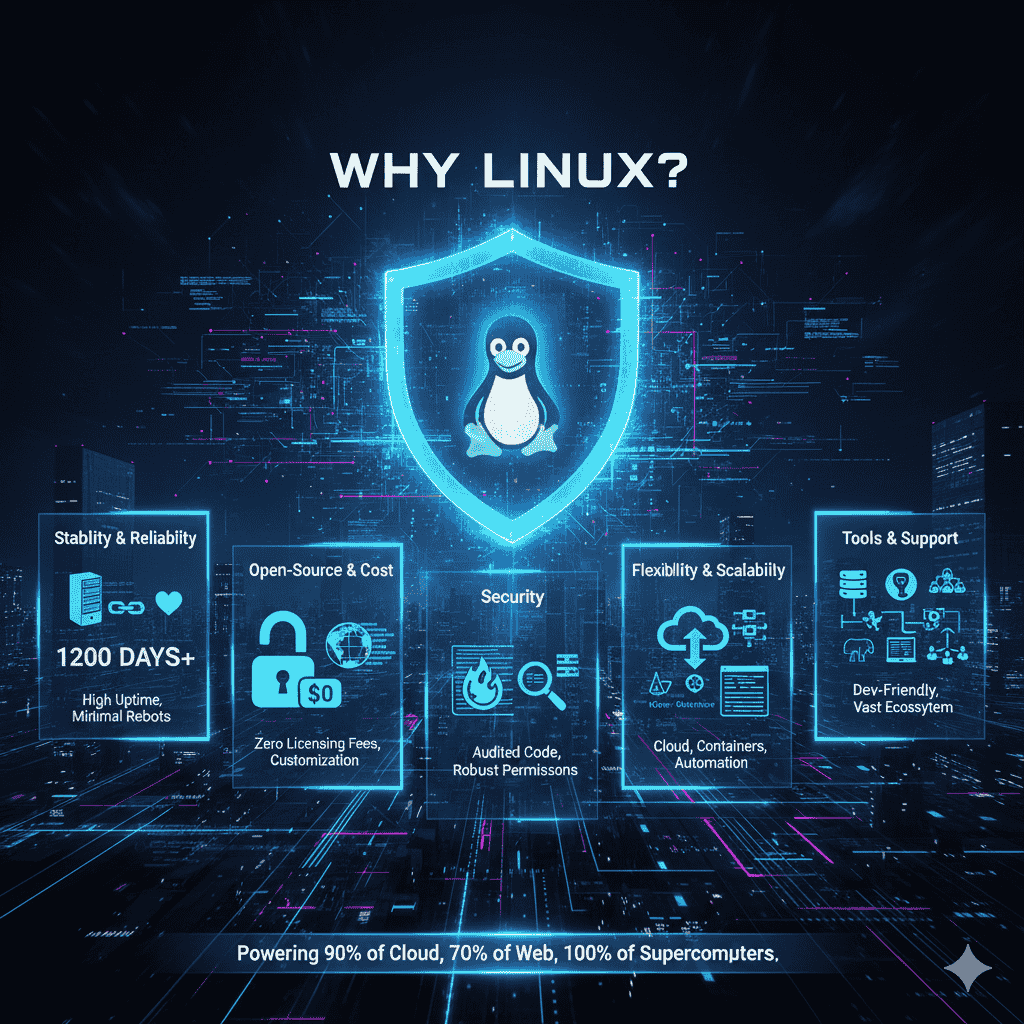
Linux currently powers over 90% of cloud workloads, over 70% of web servers globally, and 100% of the world’s top 500 supercomputers.
🔑 Key Reasons for Linux’s Server Dominance
The dominance of Linux in server environments is built upon its fundamental design principles and its status as free and open-source software.
1. Stability and Reliability (High Uptime)
Servers are required to run constantly, often for years, without crashing or requiring reboots.
- Minimal Reboots: Linux servers are known for their ability to run for months or years without needing a reboot, even after applying many system updates and patches.
- Efficient Resource Management: The Linux kernel is highly efficient at managing system resources (CPU, memory, I/O). Its design minimizes crashes and system failures, making it ideal for mission-critical applications.
2. Open-Source Nature and Cost
Being open-source provides both financial and technical advantages that proprietary operating systems cannot match.
- Zero Licensing Fees: Linux is free to use, modify, and distribute. This eliminates the massive licensing costs associated with proprietary server operating systems, significantly lowering the total cost of ownership (TCO) for businesses and hosting providers.
- Customization and Control: Developers and system administrators have access to the full source code. They can modify, strip down, and customize the operating system to install only the necessary components, creating a lightweight, optimized server tailored exactly to the workload.
3. Security
Security is paramount in a server environment, and Linux’s design provides significant inherent advantages.
- Transparency and Auditing: Because the source code is public, a global community of developers constantly audits and scrutinizes the code for vulnerabilities, leading to quick identification and patching of security flaws.
- Permission-Based Structure: Linux uses a robust user and file permission system where most services and users operate with minimal privileges by default. This design limits the damage a malicious program or attacker can inflict compared to systems where services often run with administrative rights.
- Lower Target Volume: Historically, proprietary desktop operating systems have been a larger target for general malware, which helps protect the less-common server-side Linux infrastructure.
4. Flexibility and Scalability
Linux is highly adaptable to virtually any workload, from a tiny embedded device to massive cloud infrastructure.
- Modularity: Its modular design allows administrators to install only the components needed (e.g., just a kernel and networking components), keeping the system lean.
- Command-Line Interface (CLI): Linux servers primarily use the CLI, which is fast, lightweight, and perfectly suited for automation, remote management (SSH), and scripting.
- Cloud and Containerization: Linux is the foundation for key modern technologies like Docker and Kubernetes. It powers almost all public cloud infrastructure (AWS, Azure, Google Cloud), making it the default choice for modern, scalable, and containerized deployments.
5. Wide Range of Tools and Support
- Developer Preference: Linux provides the robust environment, tools, and command-line utilities that developers and DevOps professionals prefer for building, testing, and deploying applications.
- Software Ecosystem: It supports the leading open-source server software, including web servers (Apache, Nginx), databases (MySQL, PostgreSQL, MongoDB), and programming languages.
- Community Support: The vast, global community provides extensive documentation, free resources, and quick solutions to issues.
Thank you for visiting our site! Please share this post with your friends. If you’d like us to create a new post about this topic or have suggestions for improvement, feel free to let us know in the comments, on Telegram, or via email at webdevfaizan1@gmail.com.